
The Basics
Let's start with the very very basics. Australia is divided into five states and two territories. Each of these has their own state government, whose responsibilities are generally pretty local - school curriculums, hospitals, highways. That kind of stuff. There is also a Federal Government. Their responsibilities are things like collecting taxes, running Medicare, setting foreign policy, and so on.
Apart from different areas of responsibility, the two levels are pretty similar, so in the interests of brevity I'm just going to talk about the Federal level from now on. If you want to skip ahead to the bit about the election, that's cool. This is mostly background.
The legislative arm of government is called parliament, and it consists of two houses. We were very uncreative back in the 1900s, so we nicked the names off the US (They're called the House of Representatives and the Senate) and the way they work off the Brits (they work pretty much like the House of Commons and the House of Lords, except we elect our upper house members).
The House of Reps is largely responsible for making laws, as they are the only house that's allowed to introduce bills (draft laws) that spend money. The House requires 50% plus one vote to pass a bill. All bills need to be passed by both houses before they become law. If one fails a vote, then it is sent back to be amended, which can happen a maximum of three times before it has to be dropped. It's generally considered rude to continuously block important bills like the budget, because it can cause the Governor General (the Queen's representative) to exercise their only remaining legal power and turf you all out to have a fresh election. This has only happened once, and it caused rather a mess.
For the sake of convenience, there are several parties which tend to hold blocks of seats in order to make getting their legislation through easier. Which ever party currently holds a majority in the House is called the government, and the leader of that party is the prime minister. Occasionally, like at the last election, a coalition of parties will form a government together, which causes headaches for everyone because usually they disagree with each other on stuff. I have no idea how much this was publicised outside of Australia, but the last couple of times our prime minister changed, it wasn't because of elections. It was because of exactly this type of inside-party power struggles. If you did hear about this, I'd be curious to find out how it was portrayed internationally.
Elections
Every three-ish years (there are no fixed terms, just a four year limit), the current government calls an election. The election date is always a weekend, (usually a saturday), and because this is Australia, generally timed to avoid any major sporting events. Because we would legit rather watch the cricket than go out and vote.
Except that voting is compulsory. You don't have to enrol to vote, but if you are enrolled and you don't vote, you get sent a $50 fine by the electoral commision. Americans tend to find the idea of being compelled to vote abhorrent, while we find the idea that less half the population sometimes votes a bit ridiculous. Both systems have their benefits and drawbacks, though - ours is that it results in simplistic campaigns and policies appealing to the lowest common denominator to try to sway uninterested voters.
So, you rock up to your polling place. You get two ballot papers. One is for the House of Reps, for your local Member of Parliament. There's one of these for about every 80,000 citizens, and they're elected by a local area. These tend to be more stable, as you have the same people mostly voting the same way for the same local person every election. For example, I live in a seat which has elected Julie Bishop every year since 1998, and today, we're probably going to do it again. Some people find this frustrating.
Then you have to vote for the Senate. There are 12 Senate seats per state, but they're on 6-year terms so we only elect half of them at once. Much like the US, this is because the smaller states put up a fight way back about not getting pushed around by the larger ones, who would get more House seats because of their larger population. The senate tends to be a lot more diverse, and minor parties or independents are much more likely to get elected here because they don't have to sway a whole local area - they just have to find their quota of votes, from anywhere in the population. This gives the Senate a reputation for being a check on the government's power, though occasionally one party will gain a majority in both and use it to push their own legislation through.
The way your vote works is like this: You number all the boxes, in the order prefer. Then, after everyone's '1' votes are counted, if there isn't a clear winner, the candidate with the lowest number of '1' votes is knocked out, and their votes distributed to whoever those voters voted '2' for. This process repeats until a candidate gets 50%+1 vote, and is elected. This is great, because it means you can't 'waste' your vote by voting for a minor party - which actually gives those parties a chance to get votes.
We generally know our election results, at least in terms of who will be the government, the same night, or occasionally the next morning. Counting every vote does take a couple of weeks, and sometimes Senate seats can be up in the air for a while.
The Issues
So here's who's running this election, and vaguely what issues we're basing our decision on as a nation.The Labor party currently holds government, though only tenuously. They are left-wing economically, and like to portray themselves as looking after the average Australian. They originated from, and still have strong ties to, workers unions. Hence the name. They're led by Kevin Rudd, the current Prime Minister.
.jpg/200px-Kevin_Rudd_(Pic_10).jpg)
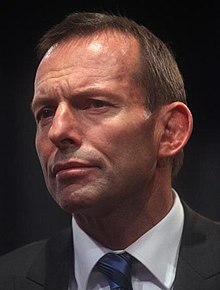
The Coalition is comprised of the conservative Liberal party (yes, confusing) and the regionally-focussed National Party. Being right-wing-ish, they generally focus on lowering taxes and reducing Government spending. They're currently led by Tony Abbott.
There are a couple of new parties too. Palmer United is run by Queensland billionaire Clive Palmer, and mostly has the policy of Clive Palmer wanting to be Prime Minister. They might win some seats, but I think they just look more significant than they are because of Palmer's penchant for spending his billions on political ads. Then there's Katter's Australia Party, run by former independent (non-party member) Bob Katter. I don't even know what they stand for.
Oh yeah, there are also a bunch of independents and minor parties.
This election, they've been mostly questioning the character of each others' leaders, though occasionally some actual policy gets announced by accident. Most people find the state of the situation generally to be "slightly bullshit", and tend to classify the lot of them as "bastards".
The policy which has actually been debated is centered around:
- Asylum seekers, and how we should deal with them. Both major parties want to 'stop the boats' (referring to how they arrive on boats), and put refugees in detention or send them to Indonesia. The Greens alone want to land them.
- The National Broadband Network, a massive infrastructure project to install fiber-optic internet in every Australian home. Started by Labor. Amazing idea, but is naturally over budget. The Coalition wants to scale it back, and just run fibre to every street corner and use the existing phone infrastructre for the 'last mile'. This will be slightly cheaper, and much slower.
- The Carbon Tax. Last term, under pressure from the Greens, Labor introduced a price per tonne on carbon dioxide emissions. The Coalition wants to replace this with an emissions trading scheme (which basically means they want the carbon price to be set by the market rather than the government.) The Labor party also want to do this because it's a reasonable idea, so nobody is quite sure what they're yelling about.
- The Mining Tax. Last term again, Labor introduced a tax on large mining companies who make extremely large profits. It was pretty unsuccessful, mostly because they introduced a bunch of concessions in order to appease the mining companies, who are basically holding up the entire economy and are the reason we didn't go into a recession with the rest of the world. The Coalition wants to get rid of this one too.
- Both parties want to return the government budget to a surplus, but disagree on how to do it. This is generally the least substantive point, as it leads to a lot of name calling about how bad the other guy is at balancing thier budgets.
- Gay marriage, which Labor supports and the Coalition opposes. Though this is a pretty minor issue for most people.
...
Okay, that turned out to be not such a short primer after all. But hopefully, you'll understand what went into the 30 seconds of handshaking and speeches you get on your TV a little better than you might've otherwise.
Thanks for reading.


